
Every scene has its instruments. Rock had the Stratocaster, jazz had the saxophone, and rave had a pile of second hand drum machines that nobody else wanted. That is the strange and brilliant thing about dance music gear. Most of the machines that defined it were commercial flops, bought cheap by broke kids who then used them completely wrong.
Here are the pieces of kit that shaped the sound you hear on a dancefloor today, and the stories behind them.
Roland TB-303 Bass Line
Released in 1981 as a robot bass player for guitarists practising at home. It sounded nothing like a bass guitar, the manual was baffling, and Roland pulled it after about 10,000 units.
Then it turned up in Chicago second hand shops for pocket money, and a group called Phuture worked out that if you twisted the cutoff and resonance knobs while the pattern ran, it screamed. “Acid Tracks” came out in 1987 and an entire genre was named after the noise. Acid house, acid techno, acid trance, all of it traces back to one failed practice tool.
If you have ever heard that liquid squelching sound that seems to melt sideways through a track, that is a TB-303 Bass Line.
Roland TR-808
The Roland TR-808 was meant to be a rehearsal drum machine, and it was widely mocked for not sounding like real drums. Which was the whole point, as it turned out.
It arrived in 1980 at around $1,195, undercutting the Linn LM-1 by thousands. The Linn used recordings of real drums and was the one serious musicians wanted. The 808 built its sounds from circuitry and sounded like a machine pretending to be a drummer without trying very hard. It sold around 12,000 units and Roland killed it in 1983, reportedly because the out-of-spec transistors that gave it its character stopped being available. Its entire sound rests on a manufacturing accident.
Then it hit the second hand market, and everything changed.
Its kick has a long booming decay you can tune down until it stops being a drum and becomes a bass note. That one trick runs from Miami bass through jungle and grime to modern trap, where “808” no longer means the machine at all, it just means the sub. A Manchester group thought enough of it to name themselves 808 State, and went on to drag rave into the charts.
Roland TR-909
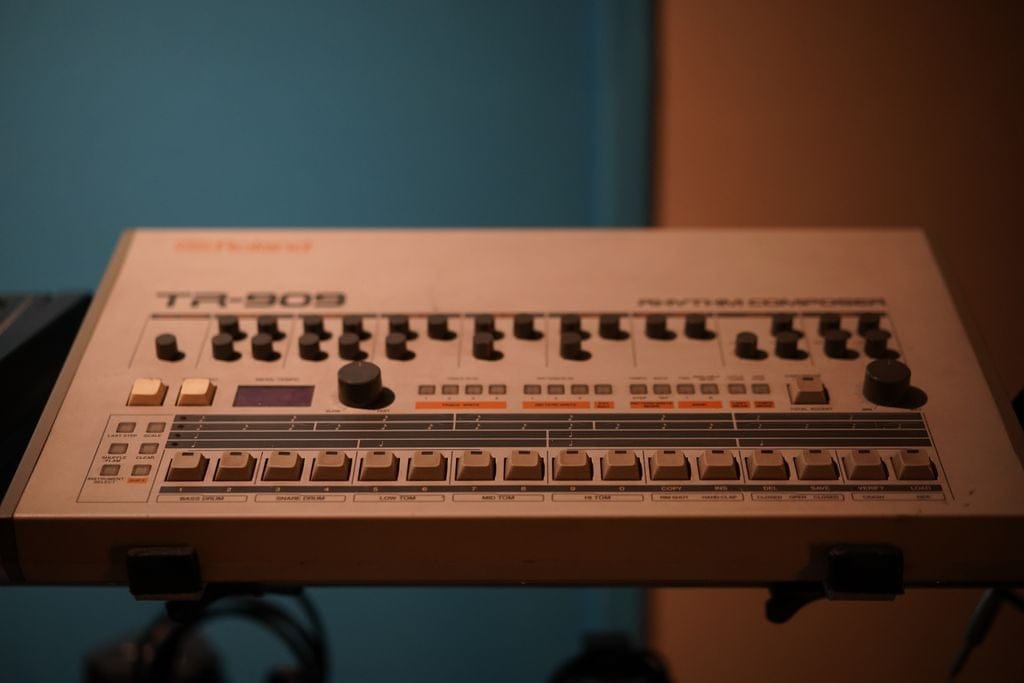
The TR-909 arrived in 1983, sold poorly, and then became the spine of techno and house.
Where the 808 is warm and round, the 909 is punchy and bright, and there is a reason for that. It is a hybrid. The kick, snare, toms and clap come from analogue circuitry, while the hi-hats, ride and crash are short, low resolution digital samples. That slightly gritty cymbal is not a flaw producers worked around, it is the thing that makes a 909 cut through a room.
The kick has a snap that survives a big rig. The open hi-hat is the sound of a track lifting off. The crash is the sound of a drop. A huge amount of classic Detroit and Chicago material is a 909 with things layered on top.
It came from Tadao Kikumoto, the same engineer behind the TB-303. And around 1984, Derrick May carried one down to Frankie Knuckles at the Power Plant, and handed Chicago what Detroit considered its secret weapon.
Roland Alpha Juno-2
This one deserves more credit than it gets. Tucked into its factory presets was a patch called “What The”, a snarling blend of sawtooth and pulse waves drenched in modulation and chorus. Producers played with it and reworked it into something far nastier, nicknaming it the hoover, because it sounds like a vacuum cleaner having a breakdown
Two of the records that made it famous landed in 1991. Human Resource built “Dominator” around it, and Second Phase, the duo of Joey Beltram and Mundo Muzique, used it on “Mentasm”. Mundo owned the Juno and sequenced the riff, though by the time it hit tape it had been run through a Casio FZ-1 sampler, which is where much of that record’s weight actually comes from.
From there the sound spread into hardcore, gabber, hardstyle and hard techno, and three and a half decades on it is still the fastest way to make a room lose its mind.
Korg M1
One of the bestselling synthesisers ever made, with somewhere around 250,000 units shifted between 1988 and 1995, and the reason so many early nineties house records sound like they came from the same room.
It was not really a synth in the old sense. The M1 was a workstation, with realistic sampled sounds, onboard effects and a sequencer built in, which meant one box could carry an entire track. For a lot of people it was their first and only studio.
Two presets did most of the work. Preset 17, “Organ 2”, was designed as a jazz organ, and house producers promptly ignored that and played it as a bassline instead. That hollow bouncing low end running under countless garage and house tracks is nearly always the same factory patch, untouched. Robin S’s “Show Me Love” is the obvious example, and it turns up again on Livin’ Joy’s “Dreamer” and, decades later, on Beyoncé’s “Break My Soul”.
The other was preset 1, “Piano 16′”, which became the sound of every hands in the air anthem of the era and launched a thousand Italian piano house records. It is on “Vogue” too.
Once you notice the M1, you cannot stop hearing it.
Akai S950 and Akai S1000 Samplers
Samplers are where rave became weird and clever. Producers in the UK were chopping up funk breaks, especially the six second drum break from The Winstons’ “Amen, Brother”, and rearranging them into something faster and stranger.
That break was played by drummer G.C. Coleman in 1969. Neither he nor the band ever received a penny from the thousands of records built on those four bars, and Coleman died in 2006 with nothing to show for the most sampled performance in history. Worth remembering, given how much of what follows rests on it.
The Akai samplers of the late eighties and early nineties had very limited memory, so people worked in tiny slices. Better still, the Akai time stretch function had a gritty grainy artefact when you pushed it hard. Instead of hiding that flaw, hardcore and jungle producers leaned into it. That crunchy smeared texture on old jungle vocals is a machine struggling, and it became part of the aesthetic.
Breakbeat hardcore, jungle and drum and bass are, in a very real sense, made of sampler limitations.
Technics SL-1200 MK2
Not a studio instrument, but arguably the most important piece of gear on this list.
The direct drive motor meant you could hold the record and it would not lose speed. The pitch fader meant you could nudge two records into the same tempo. Together those two features made beatmatching possible, which made the continuous mix possible, which made the all night set possible.
Everything about how a rave feels, that sense of one long journey rather than a series of songs, came from a turntable Technics released in the 1970’s and quietly kept building for decades.
55 Years Of Technics Spinning
This month Technics announced the SL-1200 55th Anniversary Edition, officially the SL-1200M7G, to mark 55 years of the series. It went public at DMC DJs Day in Warsaw on 20 August, with a global release set for September 2026.
It is built on the current MK7 platform, so the guts are the modern coreless direct drive motor rather than anything vintage. The changes are cosmetic and unapologetically flashy. Gold anodised S-shaped tonearm, gold tonearm base, gold rim and strobe markings on the platter, gold knobs and buttons, and a gold themed slipmat to finish it off. Each deck carries an individually engraved badge with its own serial number.
There are seven colourways: gold, blue, red, black, green, white and grey. Production is capped at 12,000 units worldwide, and here in New Zealand Mix Foundation has it listed at roughly NZD 2,499 to 2,699 depending on finish.
One nice detail to note: The SL-1200 launched in 1972, which makes 2027 the actual 55th birthday. Technics has decided not to wait, and honestly, after five decades of quietly building the same beautiful deck for the same faithful people, they have earned the right to round up.
The Home Computer
The Atari ST had MIDI ports built in as standard, which no other home computer did. Pair it with Cubase or Notator and suddenly a bedroom producer had a sequencer that could drive a whole rack of gear, for a fraction of the cost of a studio.
Over on the Commodore Amiga, kids were making entire hardcore tracks in tracker software, typing note data into columns like a spreadsheet. No studio, no engineer, no label. Just a kid with a computer and a sampled break.
This is the part people skip when they talk about rave gear, but it matters most. Cheap computers are the reason the scene came from council estates and garages rather than conservatories.
Roland JP-8000
Late nineties, and trance needed something huge. The JP-8000 had a waveform called the supersaw, which stacked seven detuned sawtooth waves into one enormous shimmering wall of sound.
Play a chord with it and you get that soaring widescreen lift that defined trance, and later hardstyle, big room and festival EDM. If a track has ever made you throw your hands up during a breakdown, there is a good chance a supersaw was involved.
Ableton Live and Native Instruments Massive
The modern chapter. Ableton Live arrived in 2001 built around loops and warping rather than tape style linear recording, which suited dance music perfectly and changed how people perform live.
Massive, released in 2007, gave producers modulation deep enough to make a bass note move and talk. Dubstep took that and ran, and the wobble bass became the defining sound of a whole era of clubbing.
Rig It Up!
Gear is not just what is on stage. A proper rave sound system is an instrument in its own right, and it changes how music lands more than any plugin will.
The difference between a rave rig and a normal band PA is headroom and subs. A good system has the low end capacity to move air rather than just make noise, often with horn-loaded bass bins that push energy forward instead of scattering it. That is why bass on a big rig is something you feel in your ribs before you consciously hear it, and why a track that sounds fine in headphones can be overwhelming in a field.
Two camps dominate. Funktion-One, Void Acoustics, Turbosound and Danley Sound Labs are the club and rave specialists. Festival main stages mostly run big touring line arrays, with L-Acoustics and d&b audiotechnik taking the lion’s share. Then there is the tradition that is not a brand at all: dub and free party crews building their own stacks by hand.
The Pattern
Look back over the list and the same story repeats. A machine gets released, fails to do the job it was designed for, ends up cheap, and someone without much money and a ton of creative vision finds a use for it that the designers never imagined.
Even the exceptions fit loosely. The M1 sold by the truckload, but the sound that made it immortal was a jazz organ preset played as a bassline by people who were not reading the manual.
Rave Music was never about having the best gear. It was about having the wrong gear and refusing to use it properly. That is still true today, and it is worth remembering next time you are staring at a plugin list wondering whether you need a better one.
Twist the resonance knob and hear what happens!