
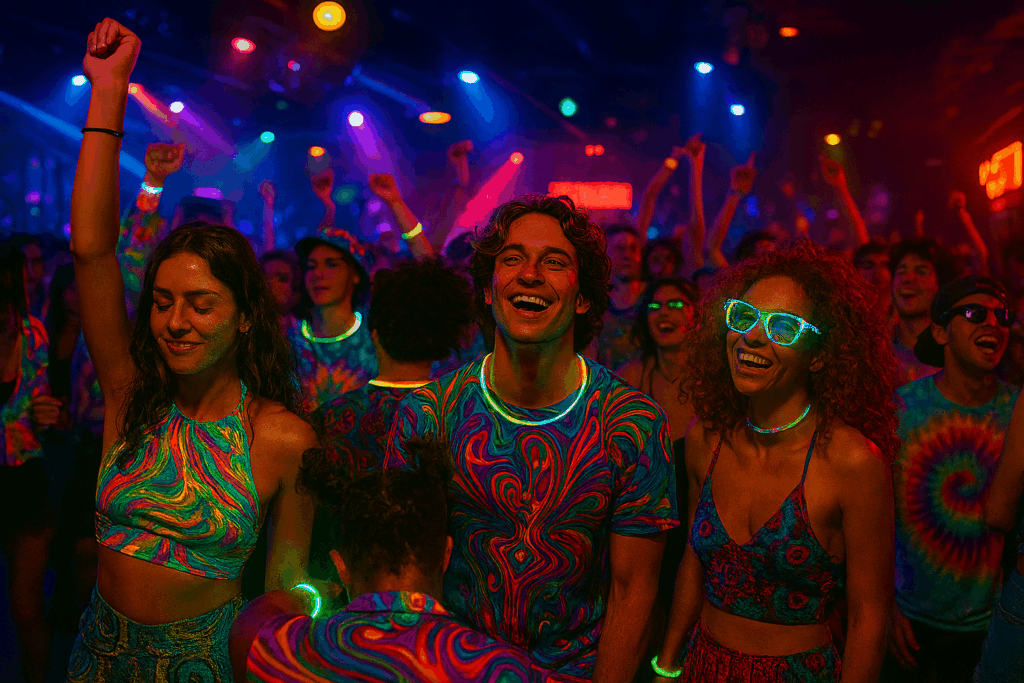
“rhythm is fundamental to the spirit/like the beat of tribal drum“
Since the late 1970’s and early 1980’s, the rhythm of ravewear and rave culture has transformed from an underground movement into a global phenomenon, with fashion and frequency evolving together to reflect the spirit of each era. What began in the shadows of abandoned warehouses has exploded into sprawling festivals, immersive art installations, and digital communities. At the heart of it all lies a symbiotic relationship between frequency and fashion – each influencing the other in a continuous feedback loop of transcendence, rebellion, and identity.
From Machines To Movement: The Roots Of Raving.
The roots of rave culture can be traced back to the 1980s, when artists from Chicago and Detroit ignited House, Acid House and Techno music. Pioneers like Frankie Knuckles, Phuture, Derrick May, and Kevin Saunderson laid the sonic foundations through ingenuity and experimentation with cutting-edge sound equipment such as synthesizers, drum machines, samplers and reel to reel tape decks. As this music echoed across the world, music producers and DJ’s embraced and reimagined these sounds, and clubs like Shoom in London and The Haçienda in Manchester became hubs for a new kind of nightlife – one that rejected the mainstream and embraced euphoric anonymity. Outdoor Music Festivals were blooming in the UK and rave fashion in this era was loud, neon, and unapologetically DIY. Baggy jeans, smiley-face tees, and glow-in-the-dark accessories, became visual signatures of a movement that thrived on creativity and sensory overload.

PLUR and the Pulse: Ravewear Gets Loud, Tribal and Transgressive
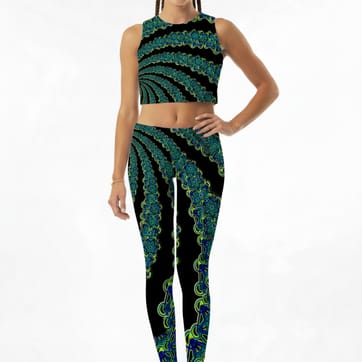
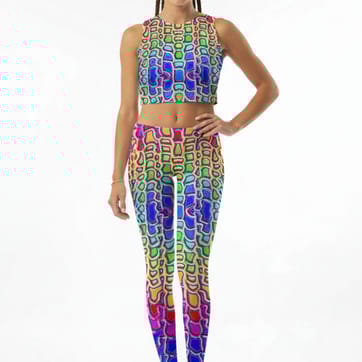
As ravers rolled into the 1990s, rave culture had splintered and spread. The ethos of PLUR – Peace, Love, Unity, and Respect – defined the community, while music diversified into jungle, drum & bass, trance, and breakbeat. Artists like The Prodigy, Underworld, Goldie, and Orbital pushed sonic boundaries to create music that was – and still is – perfectly tuned to the era. Cities like Berlin, Goa, and Los Angeles emerged as global rave capitals, and fashion responded with cyber-inspired aesthetics: Avant-garde screen printing, UV-reactive mesh, phat pants, platform boots, and Kandi bracelets became staples. In London, the rise of Torture Garden blurred the lines between fetish fashion and ravewear. Latex, rubber, and body-mod aesthetics soon spilled into techno clubs and warehouse parties across Europe. Designers and collectives like Spiral Tribe, Cyberdog, and Virus Clothing (Aotearoa, New Zealand) helped shape a look that was both futuristic and tribal, merging artistic and digital dreams with a pure creative energy.

Desert Dreams and Psytrance Rituals: Rave Go Ceremonial
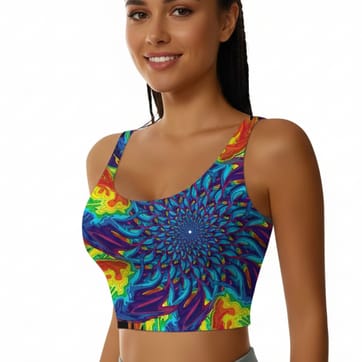
The 2000s ushered in a new wave of rave culture. Events like Burning Man in Nevada, Boom Festival in Portugal, and Rainbow Spirit Festival (previously known as Rainbow Serpent Festival) in Australia were evolving from their humble roots and redefining what a rave could be – transforming into a multi-day experience of art, music, and radical self-expression. Trance and psytrance dominated the soundscape, with artists such as Paul van Dyk, Infected Mushroom, and Armin van Buuren leading the way. Rave fashion became more theatrical and experimental, incorporating faux fur, LED accessories, smart textiles, and ceremonial wear onto the dancefloor.
Spectacle and Sparkle: Raving In The Age Of Influence
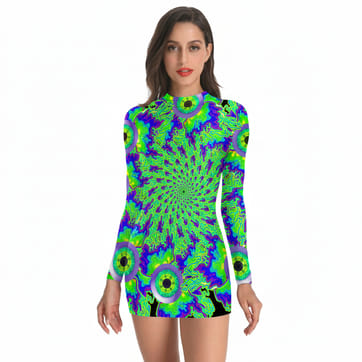
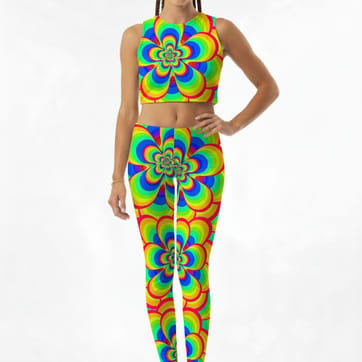
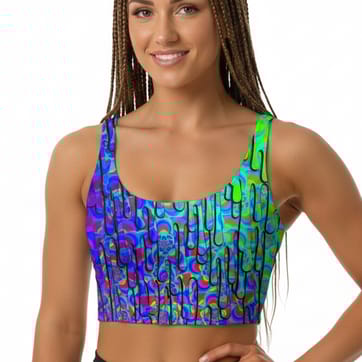
By the 2010s, EDM went mainstream. Massive productions like Tomorrowland, Electric Daisy Carnival, and Ultra Music Festival turned raving into a spectacle. Artists like Skrillex, Calvin Harris, Zedd, and Avicii brought electronic music to pop charts, and fashion followed suit. Instagram aesthetics took hold, with curated outfits featuring bodysuits, leg wraps, flower crowns, and glitter-drenched makeup. Influencer-led brands like iHeart Raves, Little Black Diamond and Freedom Rave Wear have capitalised on the demand for photogenic ravewear, turning rave and festival fashion into a booming industry.

Rooted Through Frequencies: Ravewear in the Age of Purpose
Today, in the 2020s, rave fashion is undergoing another transformation. Retro-futurism, sustainability, and cultural consciousness are shaping the new wave. Upcycled garments, biodegradable glitter, and modular designs reflect a growing awareness of environmental impact. Music is more diverse than ever, with techno, bass, experimental electronica, and indigenous soundscapes coexisting across stages. Artists like Charlotte de Witte, CloZee, TSHA, and Peggy Gou represent a genre-fluid generation that values both sonic innovation and cultural depth.
Sacred Basslines: Where Ritual Meets Rave
In Aotearoa, the scene is humming to its own frequency – rooted in whenua (land), community, and creative resistance. Collectives like NZ Psy Tribe, Dimension NZ, Audio Art, Chupa Trance, Drop Bass NZ – just to name a few – have created spaces where ritual, community and music connect. Often taking place in lush, rural bush settings and specialised audiophile venues around the motu (Island). These gatherings have helped shape a uniquely Aotearoa rave identity.

What We Wear To Transform: Rave Fashion as Collective Memory
Rave and festival fashion has always mirrored the music: reactive, expressive, and deeply personal. Clothing becomes an artistic medium for individuality and identity, while music serves as tool of transcendence and celebration. As music, fashion, and technology continue to evolve, so too will the way we dress, rave, create, and live.

Leave a Reply
You must be logged in to post a comment.